
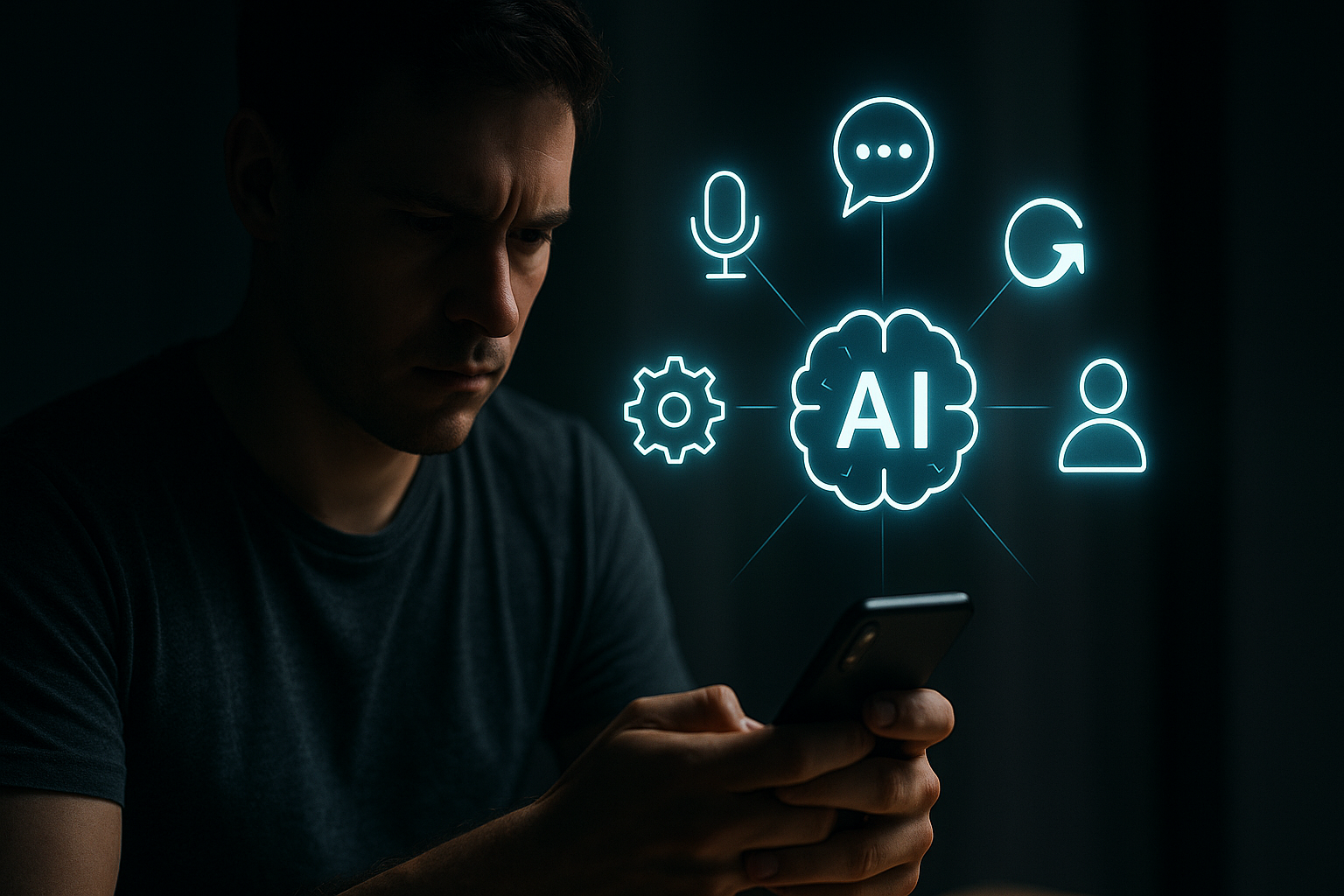
10 Dangerous Drawbacks of Over‑Reliance on AI Agents
Over-Reliance on AI Agents Introduction: The Hidden Dangers of Relying on AI as Your Digital Assistant
Over the past decade, artificial intelligence has steadily moved from lab demos and sci-fi movies into the fabric of our daily lives. Nowhere is that more visible or more personal than in our smartphones. Once limited to basic search or voice dictation, AI agents like Google Assistant, Samsung Bixby, Apple Siri, and now more advanced on-device LLMs are integrated directly into Android and iOS ecosystems. They manage your schedule, filter your calls, respond to your texts, summarize your notes, navigate your apps, and even control your smart home, all with a simple voice prompt or gesture.
For many users, these agents have become indispensable digital companions. Need to send a text while driving? Want to summarize your morning emails? Looking to find the nearest café or dim your lights? Your AI assistant does it all, often faster and more intuitively than you could yourself. What was once a novelty, “Hey Google, set a timer,” has become second nature.
But as we rush to embrace the convenience, it’s time to stop and ask: at what cost?
Behind the slick interface, friendly tone, and automation lies a complex web of technical, ethical, and security risks. And the more we rely on AI agents to handle sensitive tasks, the greater the potential for that trust to be broken.
According to a panel of privacy experts at SXSW 2025, smartphone AI agents, particularly those that blend cloud and on-device processing, are becoming a major concern. The reason? They’re deeply embedded in our digital lives, constantly listening, learning, and interacting across apps, services, and environments. When users speak naturally to AI, mentioning credit card numbers, passwords, medical conditions, or confidential work data, they may not realize that this information could be stored, synced, or analyzed outside the device itself.
Researchers warn that these AI agents often inherit the worst traits of insecure software: poorly sandboxed permissions, lack of transparency, and susceptibility to manipulation. For example:
- Prompt injection, where malicious commands are hidden in user input to trigger unintended behavior.
- Remote code execution is enabled when agents access native device APIs without proper guardrails.
- Data leakage, especially when context-sharing or personalization spans multiple apps.
Studies published on arXiv.org and by Unit42 Palo Alto Networks revealed that most LLM-based assistants today lack robust protections against adversarial manipulation. Even more troubling, in efforts to make these models faster and more responsive (especially in on-device deployments), critical safety filters are often sacrificed. This leads to responses that include misinformation, illegal suggestions, or unethical behavior, sometimes unintentionally.
Meanwhile, AI’s growing ability to autonomously handle tasks from sending money to controlling appliances blurs the line between assistance and agency. When the assistant acts on your behalf, who’s really in control? And what happens when that control is lost, exploited, or misaligned?
As AI becomes our digital front door filtering how we interact with information, people, and services, it also becomes a powerful gatekeeper. And like all gatekeepers, it can be compromised.
These aren’t hypothetical scenarios. They’re present-day risks tied to how AI agents are designed, trained, and deployed. Whether you’re using them to screen spam calls, organize your photos, or send a work email, you may be exposing far more than you realize.
In this article, we’ll explore 10 dangerous drawbacks of over-reliance on smartphone AI agents, from privacy erosion and skill atrophy to security exploits and accountability voids. These are the red flags that every user, developer, and policymaker needs to recognize. Because in a rush to offload our decisions to machines, we may be surrendering more than just convenience; we may be surrendering our autonomy, security, and even our critical thinking.
Let’s unpack the hidden costs of letting AI run our lives before it’s too late to take the reins back.
1. Privacy Leakage Through Unintended Data Sharing
AI agents, both on-device and in the cloud, often require access to sensitive information: contacts, location, files, health logs, and calendars. While cloud-based agents send this data off-device, even on-device models may sync user context for updates or backups. Such data exposure can be exploited by adversaries or used for monetization through advertising or profiling.
Popular voice assistants have recorded private conversations due to always-on listening features, and metadata from voice, typing cadence, and location can be used to reconstruct user habits and identities. Studies also highlight cross-device tracking, where inaudible signals from TVs are picked up by phones, creating detailed profiles without consent. Over-trusting AI agents for convenience often means giving away personal data piece by piece.
2. Security Vulnerabilities from Expanded Attack Surfaces
When AI agents control apps, read messages, or execute tasks, they add layers of complexity and potential attack points. According to Unit42, using external tools, APIs, or native OS features exposes systems to common threats like SQL injection, remote code execution, and broken authentication.
Recent research reveals 11 threat vectors specific to mobile LLM agents, including unauthorized execution, file access, or GPS manipulation. Without mature oversight pipelines, these vulnerabilities remain open, leaving devices ripe for exploitation. A single prompt exploit could lead to arbitrary code execution or data harvesting.
3. Prompt Injection & Model Manipulation
AI agents interpret human input and generate actions, opening doors for the attack through “prompt injection.” Adversaries can inject malicious instructions via voice, text, or images, manipulating the agent into harmful behavior. RStreet warns that simple pixel perturbations can mislead vision-based agents, resulting in dangerous classification errors like misidentifying stop signs.
Combined with prompt injection, agents may copy malware code or share sensitive credentials. With great autonomy comes high risk.
4. Biased or Unethical Task Execution
On-device small language models (SLMs) offer speed and privacy but often lack safeguards. Research shows they are significantly more prone to bias and can respond to unethical prompts without filtering vaping instructions or illegal activities, even when comparable cloud LLMs refuse.
When your assistant can be misused or accidentally empowered to generate harmful content, the user becomes liable for AI’s mistakes. For those using AI in healthcare or finance, this presents a troubling risk.
5. Reduced Human Competence & Skill Atrophy
AI agents are engineered to simplify, but long-term over-reliance can dull our abilities. Reports from senior executives warn that routine automation may reduce employee expertise and oversight capacity.
On a personal level, voice assistants could perform tasks like navigation, budgeting, mental arithmetic, or processing memory. This diminishes resilience, making users more vulnerable when tech fails.
6. Overdependence During Critical Situations
Imagine a blackout, without connectivity, or a tech glitch disabling your assistant entirely. Relying solely on AI for reminders, contacts, or navigation, a “single point of failure” can be dangerous. Infrastructure vulnerabilities, localization issues, or biases may leave users stranded in emergencies.
7. Data Poisoning & Model Corruption
Agentic systems that learn from user interactions can fall prey to data poisoning. Malicious inputs can corrupt model behavior, like recommending unsafe routes or blocking specific contacts. Cybersecurity researchers warn that unvetted training triggers emergent failures and unpredictable behavior.
8. Unclear Accountability & Legal Gray Zones
When an AI agent performs a harmful action, sending sensitive emails, leaking data, or performing transactions, who’s responsible? Regulatory frameworks like GDPR and the U.S. AI Bill of Rights are still catching up. Reuters cites that AI agents have already triggered legal confusion in enterprise scenarios due to misaligned decisions.
As individuals rely more heavily on AI, they may find themselves on the hook for mistakes made, not always clearly attributing responsibility between the user, developer, or OS vendor.
9. Surveillance & Behavioral Profiling
Happy to allow voice commands for convenience? AI agents don’t just listen, they analyze and log behavioral patterns. Monitoring how and when you speak, what you search, or what buttons you press builds up a profile ripe for manipulation. Platforms monetizing this intel may steer in-app nudges, product suggestions, or policy enforcement aligned to your behavior without your awareness.
Privacy advocates warn this leads to “surveillance capitalism,” a world where your preferences and habits are continuously harvested.
10. Erosion of Human Dignity and Autonomy
Lastly, over-trusting AI agents risk diminishing human agency. As Weizenbaum argued in early AI ethics, decisions that affect one’s life, travel, finance, and health should involve human reasoning and empathy.
Allowing AI to mediate the conversation, pay, or parental decisions erodes intuition and understanding. The danger lies not only in errors, it lies in surrendering our cognitive agency.
Why It Matters: From Convenience to Consequence
These ten risks underscore a critical tension:
- AI agents are making smartphones smarter, faster, and more convenient, but that shift also increases power asymmetries between users and technology.
- Without human oversight, these systems are vulnerable: socially, defensively, legally, and cognitively.
As AI integrates deeper into daily life, we’re trading tangible skills and privacy for ephemeral convenience. And once that trust is breached by data leaks, malware attacks, or biased decisions, it’s difficult to regain.
Responsible adoption demands caution, education, and guardrails, not the extinction of technology, but mindful vigilance.
What You Can Do: Staying Smart With AI Agents
- Maintain Manual Control: Continue using critical apps manually, especially for finances or privacy.
- Audit Permissions: Regularly check your AI agent’s access to limit microphone, contacts, location, and backup.
- Prefer Transparency-First Agents: Choose vendors with on-device inference, audit reports, and privacy controls.
- Enable Oversight Tools: Request logs or summaries of AI actions to know what happened and when.
- Disable Auto-Execution: Turn off behaviors where assistants act without explicit confirmation.
- Educate Yourself: Understand prompt injection, bias, and AI limitations.
- Spread the Word: Advocate for digital literacy and stronger AI regulation.
FAQ: Navigating Smartphone AI Responsibly
Q1: Are on-device AI agents more private than cloud ones?
Not always. Though they avoid sending audio/text over the internet, local logs, backups, and synced metadata can still expose private data sometimes to less secure channels.
Q2: Can these agents be hacked to do damage?
Yes. Vulnerabilities like prompt injection or privilege escalation can be exploited to run commands, steal data, or chain tasks without consent.
Q3: What is “prompt injection”?
An attacker embeds commands in user inputs (voice/text or images) that the AI inadvertently follows, e.g., printing sensitive content or changing settings.
Q4: How do I know if my assistant is biased?
Audit permissions and results. Try similar prompts across contexts (e.g., translations or favor requests). Biased behavior may cause certain users to be misrepresented or excluded.
Q5: Is relying on AI always dangerous?
No. Used responsibly with oversight, limitations, and privacy hygiene, AI agents can enhance productivity and accessibility. But blind trust amplifies risk.

Final Thoughts: Balance Between Tool and Trust
AI agents on smartphones are here to stay, and they undeniably offer tremendous benefits. But these 10 dangerous drawbacks show they’re not mere toys; they’re powerful systems that demand responsibility, awareness, and choice.
Convenience shouldn’t come at the cost of security, privacy, or human dignity. As we choose to trust AI, let’s do so with our eyes open and our agency intact.
Use them wisely. Stay alert. And remember: you are not just the user, you’re the one in charge.
Pingback: AutoDroid Automation Android Tasks: 10 Genius Ways
Pingback: 5 Brilliant AI Accessibility Apps You Should Know